



Great photos get guests to click “book.” A great review only comes from what happens between booking and checkout — and communication is the thread that runs through all of it. Two hosts can offer the exact same apartment, the same amenities, the same price, and end up with wildly different star ratings. The difference is almost never the mattress. It’s the messages.
The Hidden Rating Category Nobody Talks About
Airbnb’s review system asks guests to rate cleanliness, accuracy, value, location, check-in, and communication. Most hosts obsess over the first five and treat communication as an afterthought — something you handle reactively when a question comes in. But communication isn’t a side category. It colors every other score.
A guest who feels informed and cared for will forgive a noisy street or a quirky shower. A guest who feels ignored will nitpick the thread count. Communication is the lens through which everything else gets judged.
Why This Happens Psychologically
When people feel uncertain, they get anxious. Anxiety makes people scrutinize their surroundings for problems. A guest who can’t get a response about parking will walk into your space already primed to notice flaws. A guest who received a warm, clear message about parking, the door code, and the quirky water heater walks in relaxed — and relaxed guests are generous reviewers.
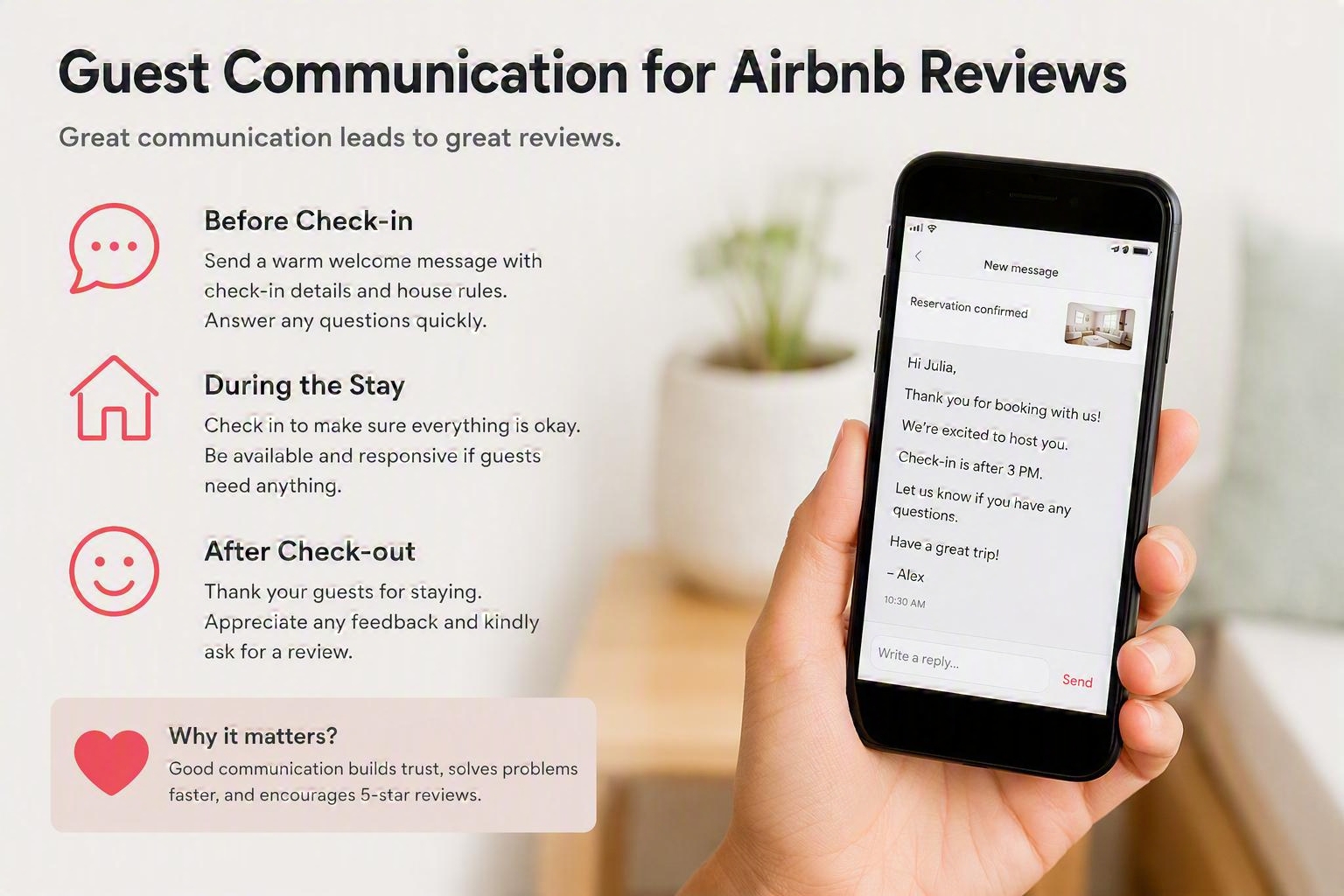
The Four Moments Where Communication Matters Most
1. The Pre-Booking Questions
This is a guest’s first real interaction with you as a person, not just a listing. A fast, friendly, specific answer signals competence. A slow or vague one plants the first seed of doubt — sometimes before they’ve even booked.
2. The Pre-Arrival Window
This is where most hosts either shine or quietly fail. A good pre-arrival message answers questions before they’re asked: exact check-in steps, parking instructions, wifi details, and a heads-up about anything unusual (a tricky lock, a noisy neighbor, construction nearby). Guests who arrive prepared don’t leave reviews about being “surprised” by anything.
3. During the Stay
Most hosts don’t need to message much during a stay — and that’s fine. But availability matters more than frequency. Guests don’t want constant check-ins; they want to know that if something goes wrong, a real person will respond quickly. A single fast, helpful reply during an issue can turn a potential complaint into a five-star mention of “amazing communication.”
4. Checkout and Beyond
A simple, warm checkout message — thanking them, confirming checkout steps, and inviting feedback — closes the loop. It’s a small thing, but it’s often the last impression before they sit down to write a review.
What “Good Communication” Actually Looks Like
Good communication isn’t about message volume. It’s about removing friction. That means:
⭐ Speed — Responding within an hour or two, especially in the first 24 hours after booking and the day of arrival.
⭐ Clarity — No guest should have to guess where the key is or when checkout time actually starts.
⭐ Tone — Warm and human, not templated and robotic. A message that reads like a form letter feels like talking to a company, not a host.
⭐ Anticipation — Answering the next three questions before they’re asked, instead of waiting for guests to hunt for information.
The Cost of Getting It Wrong
Poor communication rarely shows up as a single dramatic failure. It’s usually death by a thousand small omissions: a door code sent five minutes before check-in, an unanswered question about early arrival, silence during a maintenance issue. None of these feel catastrophic in the moment — but they add up to a guest who feels like an afterthought. And guests who feel like an afterthought write reviews that say so, even indirectly, in phrases like “communication could be better” or “took a while to hear back.”
Those reviews compound. Airbnb’s algorithm favors listings with strong recent reviews, so a string of “fine but distant” experiences can quietly suppress a listing’s visibility for months.
Turning Communication Into a Competitive Advantage
The hosts who consistently earn Superhost status and five-star review streaks tend to treat communication as a designed system, not an improvisation. That usually means:
- A templated but personalized welcome message sent automatically at booking.
- A detailed pre-arrival guide covering everything a guest might need, sent 24–48 hours before check-in.
- A standing habit of checking messages at least twice a day during active stays.
- A short, genuine checkout message that closes the experience on a warm note.
None of this requires being glued to your phone. It requires being predictable — guests trusting that a message will get a timely, helpful reply is often worth more than the reply itself.
The Bottom Line
Reviews aren’t really about the space. They’re about how a guest felt during their stay — informed, cared for, and unsurprised, or confused, ignored, and on edge. Communication is the mechanism that decides which of those two experiences a guest has. Get it right, and even an average apartment can rack up five-star reviews. Get it wrong, and even a beautiful one won’t be enough to save the rating.